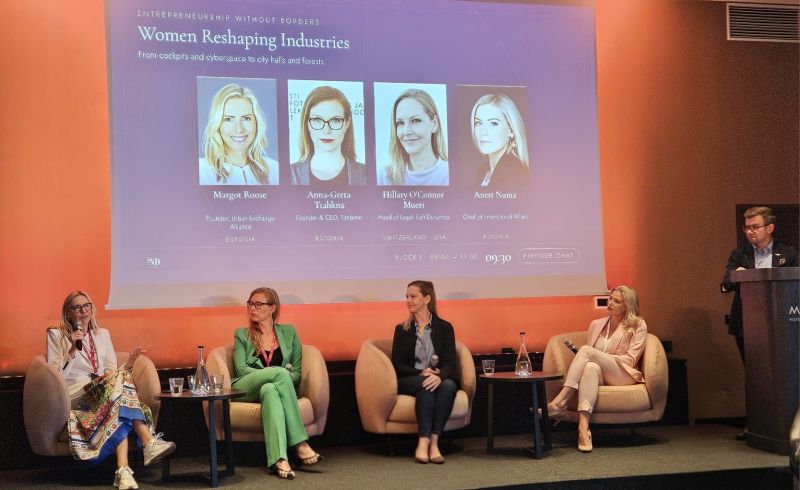
Only around 5% of the world’s mayors are women. In Europe, it’s 15%, and that we already call progress. That was the starting point for our founder Margot Roose at the panel “Women Reshaping Industries: from cockpits and cyberspace to city halls and forests.”
Cities were always meant to be places of opportunity. That promise was just never written with everyone equally in mind. Where the sidewalks go, how well they’re lit, where the bus stops, whether a sidewalk is walkable after snowfall: these get decided almost entirely through one set of eyes. So do how much productive time someone gets in a day, whose health suffers more from poor air quality, and whether there’s daycare close to home.
In Brussels in 2025, Margot sat in a room of female city leaders where a mayor shared that she had been physically assaulted over a zoning decision, and decided not to run for a second term. At that same event, she signed the Women Mayors’ Declaration for Safe and Inclusive Governance. That’s the extreme end of a pattern that mostly shows up in much quieter ways. This isn’t about blame. It’s about who’s in the room when decisions get made.
Points from the panel worth remembering
- It starts with confidence: not asking for a lower salary than you’re worth, not saying no to an opportunity because you don’t feel 100% ready.
- Women supporting other women, actively, not just in theory.
- The invisible tasks, at home and at work, need to come into the light.
- Male-dominated sectors won’t attract women by saying they need more women. They have to become genuinely desirable places to work.
- To the men in the room: if a decision doesn’t serve everyone, someone needs to tell you, because most of the time you don’t realise it.
With Anna-Greta Tsahkna, Hillary O’Connor Mueri and Anett Numa. Thank you to ÄND Women, Malle Post and Marko Post for organising “Women Shaping the Future”.